Texas Film Sites 1: TRUE GRIT

Exterior

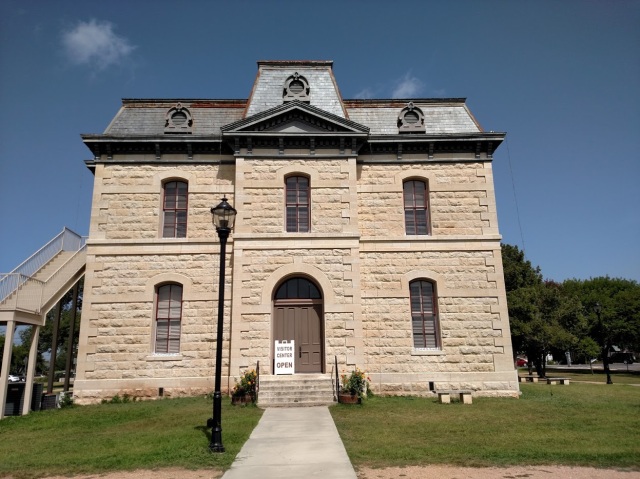
The world’s most symmetrical building: The Old Blanco County Courthouse

This summer, I was on vacation with my family in the Texas hill country, when I stumbled accidentally into a site of interest for this blog. Cinephiles everywhere can spot the many uses of Monument Valley in John Ford’s westerns, or the LA’s iconic Bradbury Building in everything from sci-fi classic Blade Runner to the silent film tribute The Artist. But it is a real joy to find a hidden gem of a film site, right here in my home state. In the first of what I hope to be a series of posts about lesser known film locations in Texas, I would like to share my discovery of the Old Blanco County Courthouse in Blanco, Texas. You can read about the history of the building, which is now a visitor’s center and event venue, at their website.

Joel and Ethan Coen’s terrific 2010 version of True Grit features a memorable introduction of Jeff Bridges’ Rooster Cogburn as a witness in a courtroom scene. This scene and the following one on the staircase are shot in the interior of the Old Blanco County Courthouse.
Continue reading

Happy Birthday to me

vlcsnap2012021600h38m59s236

Get it?

F for Films celebrates 1 year in the blogosphere!

My first real post, The Suspension of Belief, was published on June 9, 2015. Since then I’ve had a lot of fun, and met a lot of cool cinephiles online. I didn’t know if this blog would be a flash in the pan for me, but I’ll keep it going at least another year I think before I burn out!

Please like and share my new Facebook page if you have enjoyed anything I’ve written here.

Sincere thanks for everyone for reading, and especially for commenting and sharing your thoughts. This has been more fun than I imagined when I started it up, thanks to you people out there in internetland. Thank you!

THE TRIAL (and The Prisoner)

Screenshot (21).png


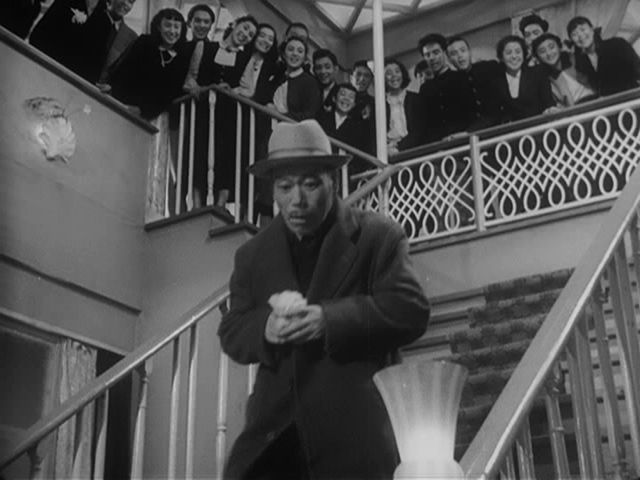
Early open concept workplace. Nightmare both then and now.

Welles and The Trial

Orson Welles’s 1962 film, The Trial, was his own loose adaptation of Franz Kafka’s German language novel from 1925. It has been justly celebrated by critics and Welles aficionados as one of his finest achievements, and is one of the few projects that he retained control of through the finished product. It is a masterwork of direction, writing, set design, and acting, but is sadly not known as well as many of his other works, probably due to the lack of a proper home video release in the US.* The film will somewhat resist interpretation, because as the narrator (Welles) famously says at the conclusion of the introduction: “It has been said that the logic of this story is the logic of a dream, of a nightmare.” Which is to say, no logic at all.

Continue reading

Promotion Reciprocation Explosion


tumblr_mxidye74nz1roe6alo2_500


My goal in starting this blog was not so much to foist my opinions on the already overcrowded world of the blogosphere, but more to try to join in a conversation about movies that I love, and provide a chance for me to learn more about film in general. I find that I learn what I really think when I try to express it in writing. I don’t always feel that I’m successful in expressing my thoughts, but at least the attempt has been satisfying. The blog has evolved already a bit in the last year to be more focused on specific films and less on the sort of generic musings that I attempted in last summer, but I’ll probably return to some of those types of posts as time and inspiration strike.

The community aspect of blogging has been greatly aided by my participation in some blogathons, which has introduced me to a number of other great blogs, as well as bringing a lot of new readers here. I was a real skeptic about Twitter for a very long time, but I’ve come to appreciate it for what it is able to provide in terms of interaction as well. If you want to connect there, I’m @magadizer. I also recently created a Facebook page for the blog, so if you follow my blog, I’d be grateful if you would like the page there and share as well.

Continue reading

Blind Spot 2016: The Bad Sleep Well

Screenshot (65).png

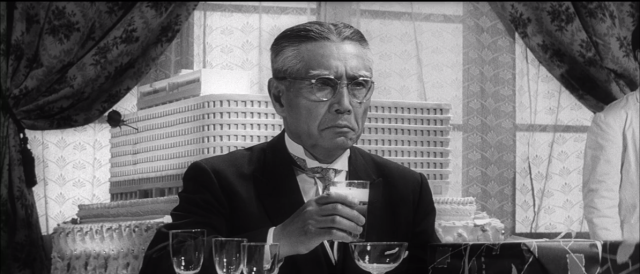
The Groom’s cake has an unusual theme.

I have been gradually making my way through the filmography of the great Akira Kurosawa. Thanks to some bargain eBay purchases, the public library, and a three month subscription to Hulu, I should be able to access just about every one of his films except, I think, Dersu Uzala. I recently watched his adaptation of Gorky’s play The Lower Depths. That was the first time seeing a Kurosawa film that I didn’t take much away from it. It contains a lot of scenes of miserable folks wallowing in a squalid tenement, with the only real plot elements coming from a love triangle (or maybe a love rectangle) between a thief, the landlord, the landlord’s wife, and her sister. To me, it was a great example of the difficulty even a master filmmaker like Kurosawa can have in translating a stage work into a successful film. Dramatic forms that seem so similar (plays and narrative films) are really far apart it seems in their means of artistic expression.

Continue reading

Four Bugs Bunny Cartoons from 1949

Screenshot (58).png

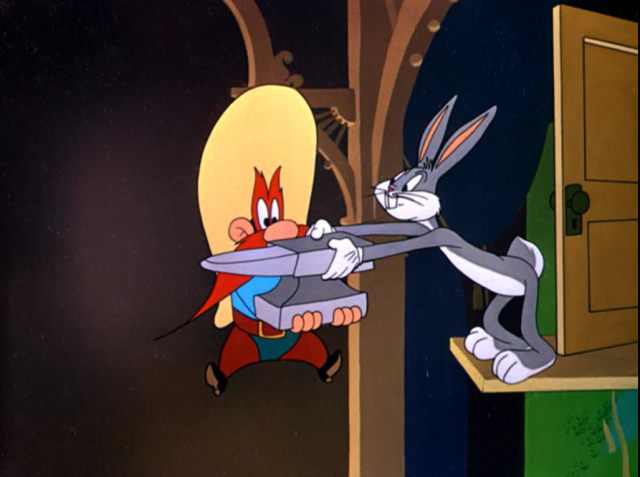
Can’t write about cartoons without an anvil, right?

In 1949, the Warner Brothers cartoon studio was at their peak. They had established most of their enduring and beloved stable of characters, and were building on the legacy of legendary directors such as Bob Clampett, Tex Avery, and Frank Tashlin. The post war years saw the establishment of a more settled arrangement of working relationships in the four (reduced to three in 1947) units under the direction of Friz Freleng, Chuck Jones, Bob McKimson, and Art Davis. They still had the fantastic decade of the 50s ahead of them, but around this time sees where the comic formulas, peculiarly witty dialogue, and animation designs really crystallized into the most recognizable feeling, before suffering a very slow decline through the late 50s and into the 60s. And the biggest star of the Warner stable, capturing all of these traits in the many films he starred in, was Bugs Bunny.

Continue reading

Mr. Arkadin – The Great Villain Blogathon 2016

Arkadin unmasked.png

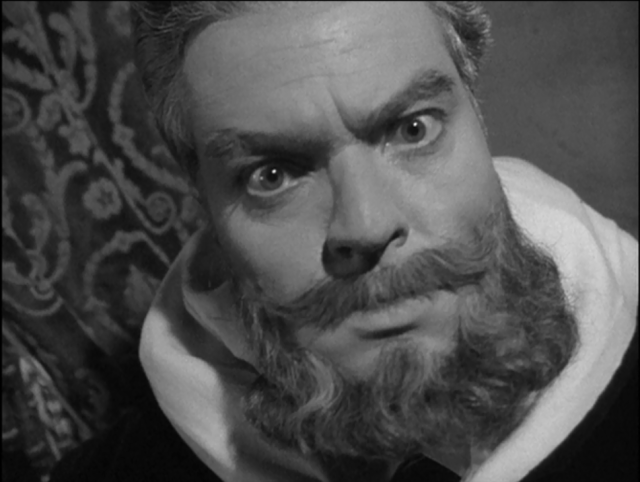
The eponymous villain of our story.

Mr. Arkadin, the film, may be regarded as a minor work in Orson Welles’s oeuvre, but his characterization of Mr. Arkadin provides a vehicle for some of his most subtle ruminations on the nature of evil. The film, released in various versions around the world starting in 1955 (and sometimes given the alias Confidential Report) is a convoluted potboiler, relatively unremarkable in the basic outline of the scenario, and steeped in the noir and crime fiction tradition. But through the distinctive editing, camera angles, and stylistic flourishes in the costuming and makeup, Welles gives us more than a first glance might afford. We find an exploration of sin, duplicity, and the grotesque that makes us question what makes a person a villain, and perhaps implicitly looks for a spiritual source for redemption.

Continue reading

Blind Spot 2016: The Thin Blue Line

TBL Title

A film by Errol Morris, 1988.

Though Errol Morris has been increasingly prolific in film and television work since the early 2000s, his first few works were released more slowly. Prior to his 1988 documentary (or “nonfiction film” as some would have it) The Thin Blue Line, he had only made two other films. His 1978 debut, Gates of Heaven, is an eclectic examination of the owners and patrons of a pet cemetery, which manages to evoke deeply spiritual and human concerns despite—or because of—the sometimes vain and superficial subjects. Roger Ebert praised it in the highest terms, as “one of the greatest films ever made.” It was his “Great Movies” review which inspired me to take a look at Morris’s work for the first time.

Continue reading

In Which Participation in Upcoming Blogathons is Enumerated

giphy

Dr. Tobias Fünke optimistically numbers the readers of this blog. (source)

Since I began this blog last summer, I discovered the wide world of blogathons, and have already participated in some great ones. A blogathon (goofy as the neologism may be) is a great opportunity for finding other like-minded folks who might be interested in reading what you have to write, and in turn for reading their work. I have enjoyed the chance to interact with some great writers and gracious readers, and to have some generous promotion of my own pieces by the hosts of the blogathons.

Continue reading