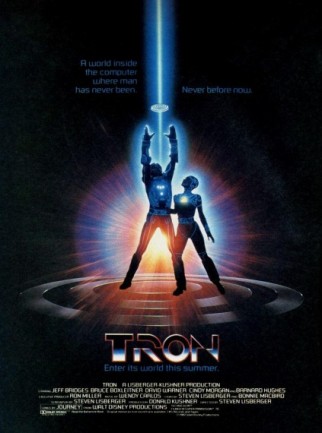
TRON – for The Blogathon from Another World


Steven Lisberger’s 1982 cult Science Fiction adventure, TRON, is a fun exercise in visual storytelling. It is the fantastic tale of a man who is beamed into the electronic world of the computer, where he is forced to survive against the villainous Master Control Program by playing video games against other enslaved programs. On the level of the computer world, the programs look like people with glowing circuit covered tracksuits and helmets. Lisberger was aiming to make a searching statement about the spiritual relationship between humans and the machines we create.  By employing the most state of the art computer generated and hand-rotoscoped animation techniques of its day, TRON explored the theme of the interpenetration of the human spirit with our technology. Something of us is in each program we create, but conversely, our technology reaches out to transform and shape the society we live in, and the individuals who make it up.

Continue reading

Fahrenheit 451 – Beyond the Cover Blogathon

“It was a pleasure to burn.”

With those words, Ray Bradbury opens his 1953 novel, which still startles with the wisdom of its warnings over a half-century later.

François Truffaut adapted Bradbury’s novel into a film in 1966. The novel and film are centered around the story of Montag, in an unspecified future time where firemen are called to burn books, and their dangerous ideas, rather than put out fires.

Continue reading

Blind Spot 2016: MACBETH

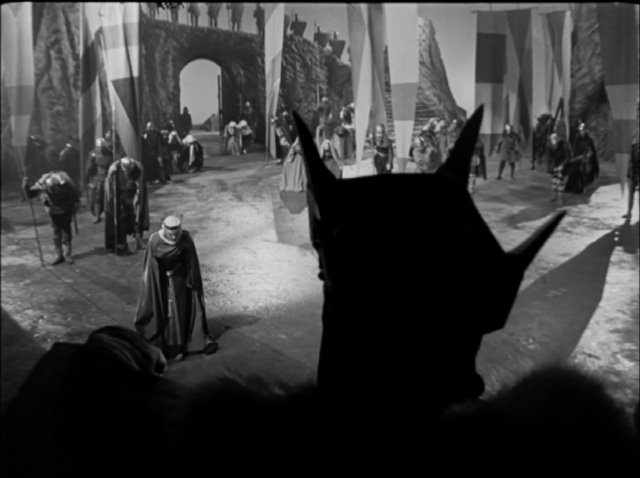
Screenshot (26).png

All hail, Macbeth, thou shalt be king hereafter!

Orson Welles’s adaptation of William Shakespeare’s Macbeth is a fascinating and partially successful experiment in translating the play from stage to film. Welles of course had a background in both theater and radio, and the legacy of both of those realms of experience is evident in his ambitious adaptation. What follows are some notes on my first viewing of the film, along with some insights drawn from Peter Bogdanovich’s interview book This is Orson Welles (edited by Jonathan Rosenbaum, 1992), and from the invaluable Wellesnet.

Continue reading

Blind Spot 2016: THE SEVENTH SEAL

The Seventh Seal 6

Death is always behind them.

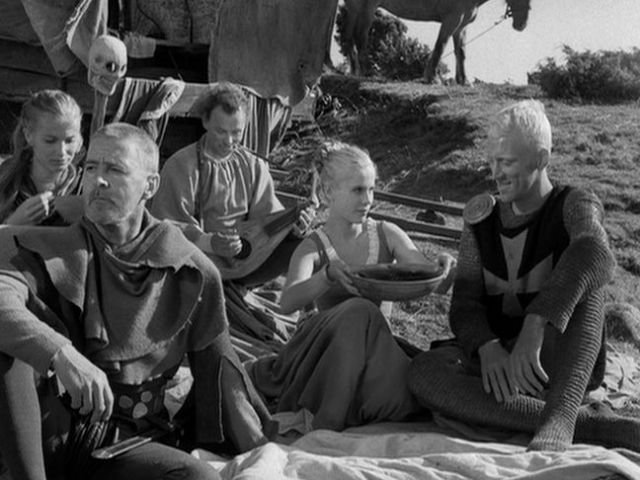
Perhaps no other film is more emblematic of the “Foreign Art Film” than Ingmar Bergman’s 1957 opus, The Seventh Seal. Endlessly referenced, parodied, and canonized, it seems that everyone who loves film has to see this. So as far as Blind Spots goes, this is a big one.

The film itself had become in my mind, before I had yet seen it, already burdened with the imposing weight of Greatness. And the stark image of Death with his arm stretched out and the black cloak billowing was already so familiar, that I expected an overburdened seriousness to pervade the film.

Continue reading

Stephen Maturin, Natural Philosopher


Screenshot (17).png

In which we are introduced to Dr Stephen Maturin.

One of the greatest fictional characters created in the 20th century is Doctor Stephen Maturin, half of the celebrated Aubrey-Maturin duo that are the subjects of a 20-volume series of novels by the late Patrick O’Brian. The series began with the 1970 novel Master and Commander, and was to be continued in a 21st volume which was in the draft stages at the time of O’Brian’s death in 2000. The books follow the career and life of “Lucky Jack” Aubrey, a Captain in His Majesty’s Royal Navy, and his close friend, Maturin, during the time of the Napoleonic Wars, from roughly 1800 – 1815.

Continue reading

Hail, HAIL, CAESAR!

character_eddie

I don’t intend this site to be for movie reviews, properly speaking, but I am inspired by the Coen Brothers’ latest film to share a few thoughts. There might be spoilers, so please refer to my newly-minted Spoiler Policy.

Hail, Caesar! is a fantastic romp through the early 50s Hollywood studio system, following the adventures of a fictional studio “fixer,” Eddie Mannix (Josh Brolin). Mannix is charged with not only ensuring that the movies Capitol Pictures are producing come out nice and shiny, but also that the public images of the stars they employ remain as pristine as possible. And so we see him visiting soundstages, screenings, and an editing room, but also at work on squelching several potential personal scandals.

Continue reading

Blind Spot 2016: DIAL M FOR MURDER


Screenshot (10).png

Caught in a Love-Hate Triangle.

For my first entry in the Blind Spot Series, I watched Alfred Hitchcock’s 1954 film, Dial M for Murder, starring Ray Milland, Grace Kelly, and Robert Cummings. I’ve been on  something of a Hitchcock kick lately, with recent viewings of Strangers on a Train, Vertigo, and Kent Jones’s Hitchcock/Truffaut.

This film is definitely what I would call second-tier Hitchcock, which is not to say that it is a bad picture by any means. The movie is adapted from a stage play by Frederick Knott, who I recently learned was also the writer of the play Wait Until Dark, which was made into a fantastic Audrey Hepburn movie in 1967.

Continue reading

Kurosawa and Nakadai: Creator and Chameleon

akira-kurosawa3

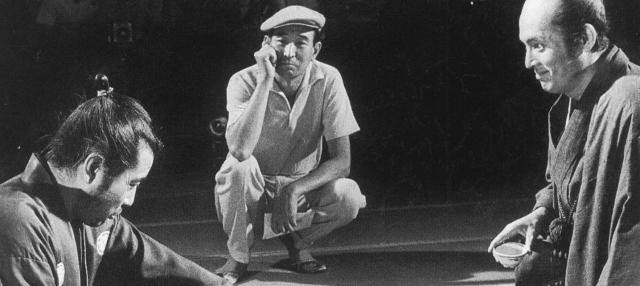
In Akira Kurosawa’s memoir, Something Like an Autobiography, he does not mention the actor Tatsuya Nakadai. This is not a slight, however, when you consider that the narrative of the memoir concludes around the time of Rashōmon (released in 1950). In the epilogue to the book, Kurosawa explains:

I am a maker of films; films are my true medium. I think to learn what became of me after Rashōmon the most reasonable procedure would be to look for me in the characters in the films I made after Rashōmon. Although human beings are incapable of talking about themselves with total honesty, it is much harder to avoid the truth while pretending to be other people. They often reveal much about themselves in a very straightforward way. I am certain that I did. There is nothing that says more about a creator than the work itself.

Continue reading

VERT-I-GO

Over the holidays, I got to see a few good films, but two stood out for their surprising thematic resonance. One was a first time viewing for me, and the other was the first viewing in a very long time. The films were Pete Docter’s Inside Out (2015) and Alfred Hitchcock’s Vertigo (1958).

One, a family fantasy-comedy told through bright computer animation, and the other a dour suspense-thriller dealing with infidelity and murder. Though the two works are in many ways as disparate as any two films can be, they both offer acute insights into the ways that emotions shape  our interactions with others, our perceptions of reality, our memories, and our deepest sense of self.

Continue reading